

Search Website
Boundary Setting
Overview
Like other professional responsibilities, supporting access requires personal resources of knowledge, energy, and time. Where developing capacity for and doing the work of supporting access can feel overwhelming, especially in contexts where institutional resources are scarce, boundary setting acknowledges real limits on individual capacity. By balancing personal needs and resources with the needs and resources of others, boundary setting creates more sustainable conditions for the ongoing work of supporting access.
Take time to reflect on your own capacity, resources and needs. Communicate boundaries in your syllabus, within assignment descriptions and communication expectations (i.e., email response times), in access statements or as part of access talk.
Rationale
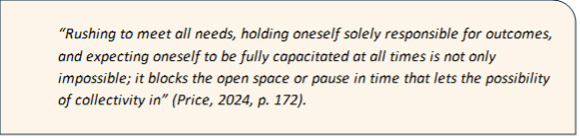
Supporting access requires a combination of individual, community, and institutional resources. Individuals may arrive at the work of supporting access with different needs and resources, including their own access needs and knowledge of accessibility. Some may have limited energy or time. Others may have a lot of learning to do to develop capacity. Whether instructors have their own access needs or not, setting boundaries as a practice that acknowledges real variations in and limitations on capacity is an important act of resistance against ableist academic cultures that promote and privilege hyper-productivity. Boundary setting promotes a balanced approach to access praxis, protecting individual wellbeing while modelling a valuable skill.
"Providing a timeline of when the profs or TAs would get back to us helped me set my expectations. Rather than emailing fairly last minute and anxiously awaiting a reply, I would know I need to email or meet by/on Wednesday (for example) because that's when personnel would be available. The day/time was usually a day or two before assignments were due. It helps them set boundaries and helps keep me on track."

Guidance
Acknowledge that developing knowledge to support access takes energy and time. Approach the work of learning and developing access praxis as a long-term process of learning, trying, failing, and improving; the practices shared in this guide are many, and in most cases, it will not be possible to implement them all right away. True praxis requires a commitment to ongoing learning, including failures, feedback, and repeated attempts.
Recommendations
 Try
Try
- Aiming for progress rather than perfection.
- Evaluating your capacity and set realistic expectations for yourself.
- Choosing a number of practices to try out or implement each term that feels manageable.
- Recognizing that capacity varies from one person to the next; what feels manageable for one person is likely to differ from what feels manageable for someone else.
- Acknowledging limitations and being transparent with your learners about your capacity and power to support different access needs.
- Requesting support as needed.
 Avoid
Avoid
- Attempting to anticipate every possible access need.
- Adopting practices that feel unmanageable. Approaching access as an individual responsibility.
Resources
Price, M. (2024). Crip Spacetime: Access, Failure, and Accountability in Academic Life. Duke UP.
In this work, Margaret Price challenges the competitive, productivity-focused culture of academic spaces and shares a collective vision of care.
Wong, A., Mingus, M., & Ho, S. (2019). Access is Love Campaign. Disability Visibility Project.
This campaign offers tips and resources for approaching access as a collective endeavour.
University Center for Teaching and Learning. Practical tips for building instructor/student boundaries. University of Pittsburgh.